
Connecting the Dots for Children: How Lanier County Is Building the Conditions for Early Literacy
By Sarah Torian
In Lanier County, Georgia, local leaders acknowledge that improving children’s language and literacy development is a shared responsibility across the community. It is understood as a shared endeavor—one that brings together educators, health care providers, libraries, businesses, faith leaders, higher education partners, banks, family-serving organizations, and many others around a shared goal: ensuring that every child has the opportunity to succeed in school and in life.
At the center of this work is the Lanier County Family Connection collaborative, led by Director Amy Griffin. For more than 15 years, Griffin has helped convene partners, examine data, identify gaps, and connect resources in ways that improve outcomes for children and families. Rather than focusing only on literacy instruction, the collaborative brings together a range of partners to ask a broader question: What conditions need to be in place for children to arrive at school healthy, supported, ready to learn, and prepared to become successful readers?
In doing so, Lanier County Family Connection (LCFC) and its partners are advancing the four pillars of the Get Georgia Reading Campaign as a framework for action, creating a shared language and a shared understanding of the conditions that must be in place for children to become proficient readers.
“We look at data every time we meet,” says Griffin of the LCFC collaborative and strategy team meetings. “The data helps us understand where we need to focus and who needs to be at the table.”
That commitment to data-driven decision making has become one of Lanier County’s defining strengths. The collaborative regularly reviews Georgia KIDS COUNT data, Census information, ALICE data (United Way’s Asset-Limited, Income-Constrained, Employed), school readiness indicators, and other local measures to identify barriers and opportunities. When data revealed high rates of single-parent households, partners began exploring ways to provide child care during community events and trainings so parents could attend and participate. When transportation emerged as a challenge, the collaborative worked to better understand existing transit options and gaps. And because low birth weight rates have been a persistent challenge for the community, even when they trend down, the health partners stay engaged to provide maternal and infant health supports and to prevent them from rebounding.
The goal is not simply to collect data, but to use it to connect the dots between what children and families need and what community partners can do together.
An example of this type of strategic and collective response emerged when local data showed that 73 percent of three- and four-year-old children in one area of the county were not enrolled in any early learning program. Rather than accepting that reality, partners created Baby Bulldogs, a community-wide outreach initiative designed to engage and enroll families by offering them a bag of books and other kid-friendly resources. Once they enroll in Baby Bulldogs, families receive a free children’s book every month, literacy resources, reminders about school registration, and invitations to community events. They also receive targeted outreach when it is time to enroll in Head Start, Pre-K, and kindergarten. The program has helped boost awareness of early learning opportunities and strengthened collaboration between LCFC and the school district around enrollment efforts.
The initiative also reflects one of Lanier County’s core beliefs: literacy starts long before children enter a classroom. That philosophy gained significant momentum through Georgia’s Literacy for Learning, Living, and Leading (L4GA) initiative. While the grant funding has ended, its impact continues to shape how the community works together.
“L4GA was one of the best grants they have ever done,” Griffin says. “The system improvements we have seen are 100 percent a result of L4GA. The improved strength of our partnership with the school district is 100 percent L4GA.”
Through L4GA, the school district became more deeply engaged in the county’s Birth-to-Five strategy team, joining partners from the health department, public library, UGA Extension, SafeCare, and other organizations and programs. Those relationships created new opportunities to align efforts around shared goals.
For example, after school leaders discussed the importance of helping young children expand their vocabulary in one strategy team meeting, UGA Extension staff incorporated vocabulary boosting approaches into Healthy Bear, an eight-week nutrition and wellness program that the extension service offers to preschool children. Healthy Bear may appear at first glance to be a health initiative, but it demonstrates how partners weave learning, wellness, and child development together in everyday experiences.
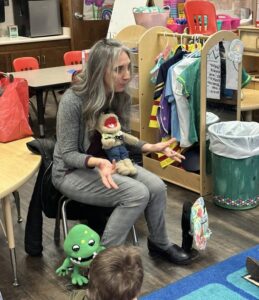
Children learn about healthy foods, handwashing, and everyday ways of staying healthy through books, activities centered on emotions, storytelling, and back-and-forth conversations that keep them actively engaged. These interactions create natural opportunities for children to connect, participate, and communicate — supporting language development and healthy habits in ways that feel connected to what they are doing.
As children talk about food, listen to stories, and take part in group activities, they are engaging with others, making sense of new ideas, and expressing themselves in context. These shared experiences naturally contribute to children’s social development and emotional regulation by creating space for them to connect with others, understand feelings, and navigate interactions in everyday environments.
Healthy Bear is a powerful example of how the Get Georgia Reading Campaign’s emphasis on language nutrition and positive learning climates create the conditions that foster early literacy development.
The same commitment to connecting the dots to support children’s early school success extends into programming designed for adults in the community. When Coastal Plain Area Economic Opportunity Authority, a local human services program shared that area families were repeatedly seeking emergency assistance without making long-term progress toward stability, community organizations, banks, churches, and UGA Extension came together to launch Budget Boss, a financial literacy and family stability initiative. One partner develops the curriculum, another provides the space for the class, another covers the cost of door prizes, and other partners support outreach.
“Instead of one organization having to master all of those different pieces and trying to do it all on their own, we have a lot of different partners providing their piece of the puzzle to make this a success,” explains Griffin.
Recognizing that low birthweight births have been a persistent challenge for the community, Griffin was intrigued when she heard that nearby Charlton County had been making significant progress in reducing rates of low birthweight births. As she investigated, she realized that DPH Home Visiting (previously known as Perinatal Health Partnership), the public health program that was helping to fuel Charlton’s progress, also operated in Lanier County but had struggled to connect with families in that county. After joining the Birth-to-Five strategy team and explaining their services there, DPH Home Visiting now has a waiting list of families to serve.
As these examples illustrate, improving literacy outcomes often requires addressing issues that may not initially appear connected to reading. Healthy pregnancies, family economic stability, strong caregiver-child relationships, quality early learning experiences, social-emotional development, access to books, and supportive schools all influence children’s readiness to learn and succeed. Lanier County’s strategy is to bring the right people together to identify those connections and act on them.
Griffin describes this as finding the “missing link.” She recalls a discussion about school attendance from several years ago. After hearing about concerning data on absenteeism, several of the partners initially assumed the challenge was concentrated among older students. School leaders quickly explained that absenteeism issues were highest in Pre-K. That insight shifted the conversation and helped partners focus their efforts where they could have the greatest impact.
“Without the school there, we would have been trying to get high school kids in school,” Griffin says. “It changed the conversation. It’s so important to have all the right people there.”
That spirit of continuous learning, partnership, and shared accountability continues to drive the work forward. As Lanier County looks ahead, partners are exploring new ways to integrate language and literacy strategies into existing programs, deepen support for families, engage employers, and strengthen pathways to economic mobility. New business partners are joining strategy teams. Existing initiatives are expanding. Data continues to guide decision making.
The work is never finished, Griffin says, because there is always another opportunity to improve outcomes for children and families. By leveraging data, embracing collaboration, and aligning community efforts around the four pillars of Get Georgia Reading, Lanier County is demonstrating what becomes possible when an entire community takes responsibility for children’s success—and when literacy is understood not as a program, but as something that grows from the conditions a community creates — together.