
From Barriers to Breakthroughs: A Framework for Action in Georgia
Literacy serves as the foundation for both personal and societal growth, yet numerous barriers hinder effective learning and literacy acquisition for far too many students. These barriers include environmental challenges, sensory issues, chronic health conditions, mental health struggles, socioeconomic disadvantages, technological inequities, and other more subtle factors. Together, these barriers disrupt a student’s ability to become a proficient reader, thereby interfering with academic success and long-term development.
One of the most pervasive barriers to learning and literacy is unequal access to learning resources and supportive environments. Lack of access to physical and mental health care providers and resources, both in schools and in the broader community, further impedes children’s ability to learn. These barriers are compounded by teacher shortages and high rates of teacher attrition.
The Barriers to Learning Subcommittee, established as a part of the Georgia Council on Literacy, examined these issues closely, exploring their root causes, impacts, and potential solutions. By better understanding these barriers, educators, policymakers, and communities can design more inclusive and effective strategies to close the literacy gap and promote equitable learning opportunities for all students.
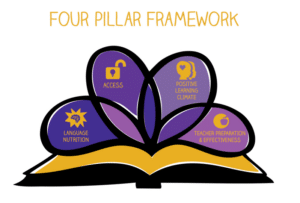
Grounded in the Four Pillar Framework of the Get Georgia Reading Campaign, the work of the Barriers to Learning Subcommittee was guided by a shared vision—North Stars: clear, overarching goals that align strategies, decisions, and actions toward long-term success. A North Star is not simply an inspiring ideal that mirrors the Four Pillars; it is a measurable and focused aspiration that paints a vivid picture of success while serving as a benchmark for tracking progress. North Stars help unify educators, families, community leaders, and organizations around a common purpose and shared outcomes. They clarify priorities and act as a filter for decisions about where to invest time, energy, and resources.
The Barriers to Learning Subcommittee identified four North Stars to guide solution-focused efforts aimed at overcoming specific barriers to literacy, each with measurable outcomes:
- Children and their families have access to, and support for, healthy development, emotional well-being, and educational achievement.
- Children experience abundant, positive, language-rich interactions with caregivers, educators, and peers.
- Caregivers and educators are equipped with evidence-informed skills to effectively engage all children through developmentally responsive practices and supportive teaching conditions.
- Children feel safe, nurtured, and connected from birth through early childhood and throughout the school years.
The April 2026 report from the Barriers to Learning Subcommittee is grounded in the belief that every student has the right to become a proficient reader. Achieving this requires a holistic and proactive approach—one that identifies and addresses barriers to learning while placing each learner’s unique context at the center of intervention planning. The complexity of the challenge demands shared responsibility. While it is neither realistic nor sustainable for a single entity to carry the full weight of this mission, the Get Georgia Reading Campaign can continue to serve as a catalyst for collective action and meaningful change.
By Garry McGiboney, Ph.D., Sharecare